
Mycelarium Upgrade Points: Tasks and Pacing
How Mycelarium progression works: length to experience, evolution tasks to bonus points, and the upgrade tree that spends them.
Mycelarium does not have levels. It has length, a diamond counter, and a tree of permanent upgrades. The loop is simple once you see it: growing adds centimetres, centimetres generate experience, experience becomes points, and points unlock the upgrades that let you grow faster. Evolution tasks sit on top as bonus objectives that pay extra points.
The system is deliberately frictionless: there is no XP bar to watch, no level-up screen, and no penalty for spending points late. That also means the game never tells you what to buy. This page explains the pipeline and the pacing decisions that follow from it.
How do you earn upgrade points?
Two sources are confirmed:
- Length. The community reports that total mycelium length feeds the point counter. This matches the achievement design, which measures growth in centimetres rather than in levels.
- Evolution tasks. The task panel lists objectives and pays points when they complete. In a developed save, several tasks show a
+2reward.
The diamond counter in the HUD is the balance. It goes up when a task completes or a growth threshold is crossed, and down when you buy a node in the upgrade tree.
What are Evolution Tasks?
Evolution Tasks are the game's quest list. They are visible in the top-left panel and on the left side of the upgrade screen. The objectives visible in a developed save include:
- Upgrade Absorption twice.
- Upgrade shot range twice.
- Drink 1,000 water from underground pools.
- Gain one upgrade point during rain.
- Shoot spores.
- Produce 30 food.
- Build five mushrooms.
- Scare off the hedgehog.
- Grow 10,000 cm.
- Build two mushrooms on trees.
- Build two Stinky Mushrooms.
These are not a tech tree. They are prompts that push you toward systems you might otherwise ignore. The water task teaches pool use, the tree task teaches surface placement, and the Stinky task teaches defence.
The list tells you what the developers consider the next system. If a task is close to completion, finish it first; the bonus point is often enough to buy the upgrade that makes the next task easier.
How should you spend points?
Spend on the exchange rate first, the systems second, and the multipliers last. In practice:
- Early: Shot Range, Water Efficiency, Absorber.
- Early-mid: Soil Penetration, Budding Chance, Node Efficiency.
- Mid: Predator branch, Water Mushroom branch, Repeller Auto Regen.
- Late: Spore branch, Consumptor branch, Digger branch.
The reasoning is that early upgrades affect every action, while mushroom branches affect one structure. A point spent on Predator Yield before a Predator exists is a point in the bank with no interest.
The upgrade priority guide→ turns this into a phase-by-phase order.
Does the tree have tiers or gates?
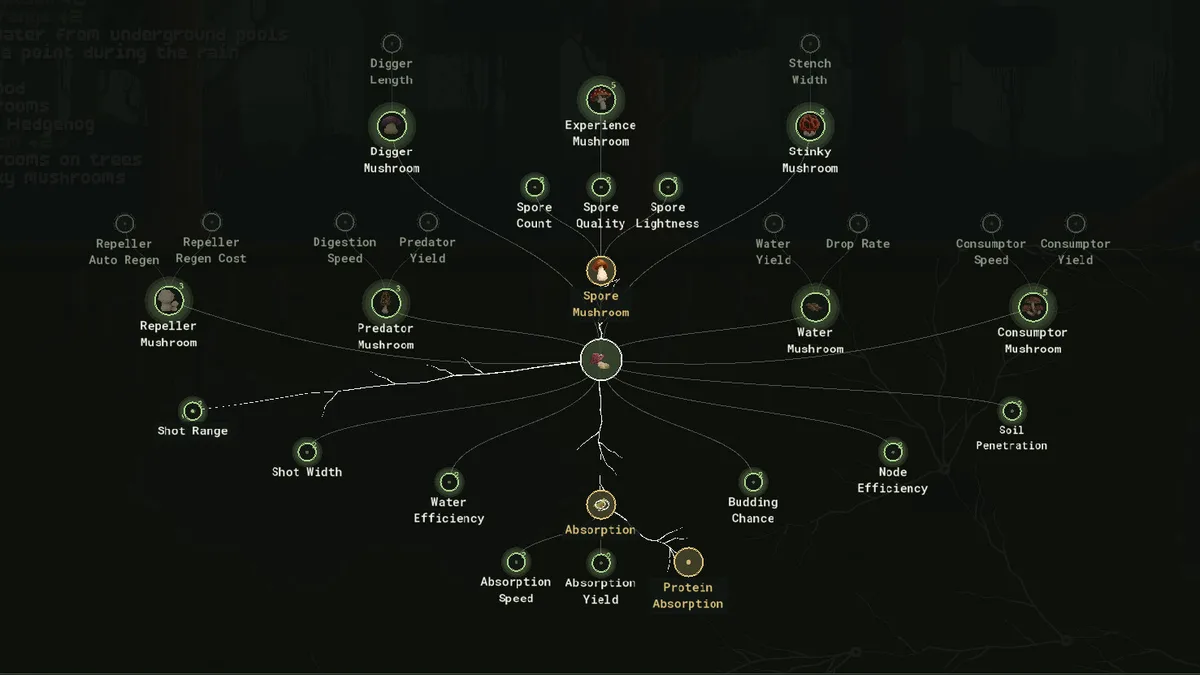
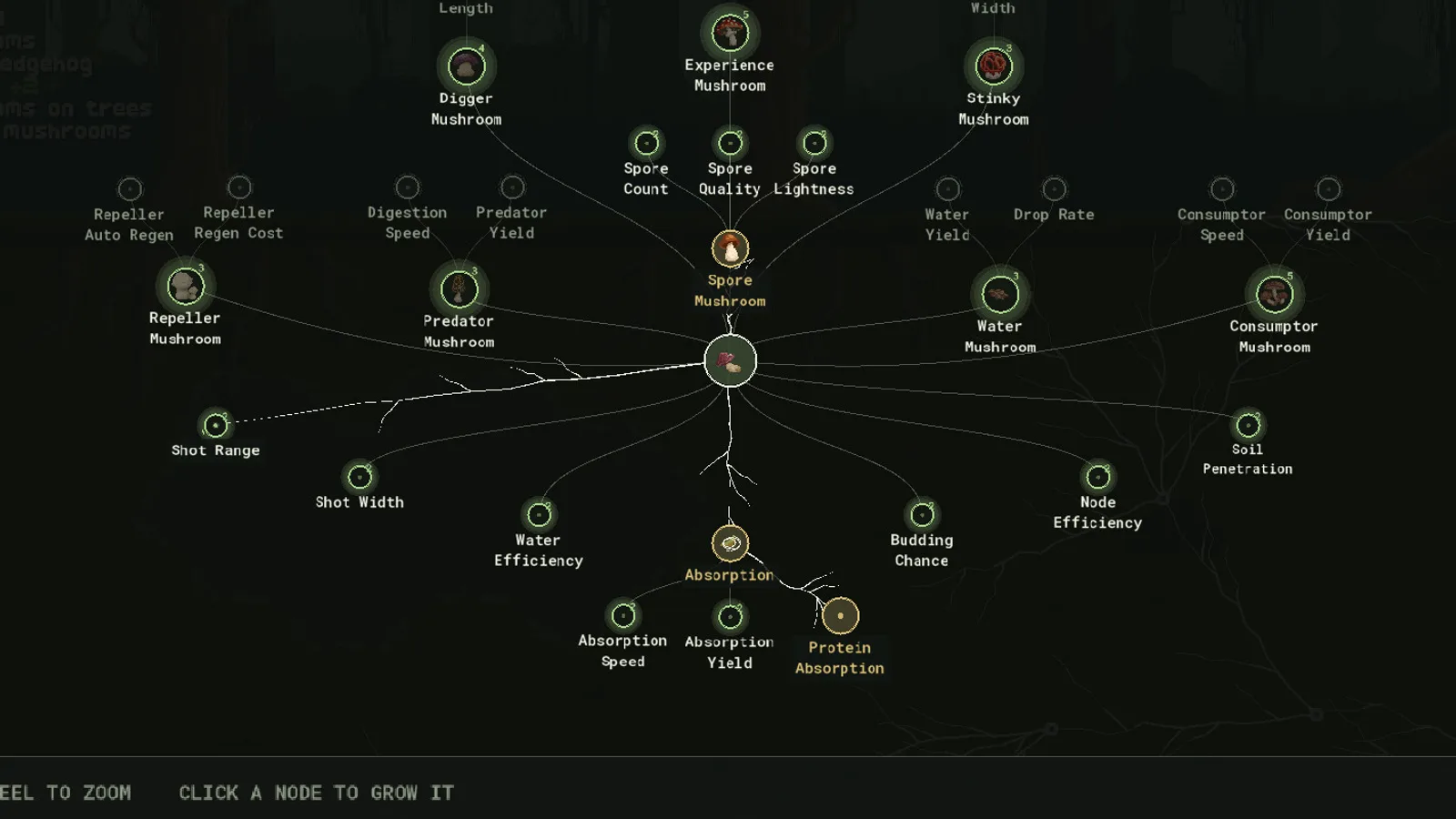
The upgrade screen shows a central root with branches radiating outward. Some nodes require a parent: Absorption Speed and Absorption Yield sit behind the Absorber, and the mushroom branches sit behind their mushroom nodes. Nothing in the screenshots suggests a separate tier system or a level requirement.
That means the tree is gated by points, not by progression flags. If you can afford a node and its parent is unlocked, you can buy it. The practical limit is that points are scarce early, so the order matters more than the total.
How fast should progression feel?
A focused player can reach the ending in about twenty minutes according to community reports, while a relaxed player can spend three hours. The difference is not skill; it is how much of the map and how many systems the player engages with.
For a first run, a steady pace looks like this:
- First 15 minutes: opening network, first Absorber, first Predator.
- 15–45 minutes: first underground layer, several magic shrooms, upgrade tree half filled.
- 45–90 minutes: second and third layers, tree branches, ending preparation.
- Beyond 90 minutes: completionist cleanup and achievements.
If progress feels slow, the usual cause is a stalled food economy, not a missing upgrade. Check the food guide→ before buying another multiplier.
What carries between runs?
The game has no confirmed meta-progression. Upgrades, length and discoveries are per-run. The achievements are permanent, and the magic shroom locations are fixed by layer, so knowledge carries even if the save does not.
Survival Mode removes the evolution tasks and the final goal, which changes progression substantially: points come from length alone, and the balance is tighter. The game modes guide→ explains the difference.
What is the fastest way to earn points?
Play the task list. Tasks pay lump sums for actions you would take anyway, and several can be completed in parallel:
- Grow toward 10,000 cm while building mushrooms.
- Connect an underground pool during rain for the water task.
- Build Stinky Mushrooms near an animal route to trigger the scare task.
- Place two mushrooms on trees once the surface network reaches a trunk.
Do not farm length in a circle. Length is earned by useful expansion, and a circular network spends water without reaching new resources.
FAQ
Is there a level cap?
No level system is visible. The upgrade tree is finite, and points stop mattering once every node is bought.
Do tasks repeat?
The visible tasks are one-time objectives. Nothing in the UI suggests a repeatable quest loop.
Can I respec?
No respec option is visible in the upgrade screen. Choose nodes with the phase order in mind.
Do points carry to a new run?
No. They are part of the current save.
Official source: Mycelarium on Steam ↗ Official source: Update 1.02 notes ↗
The Steam discussions hub ↗ has player reports on point income and fast runs; the achievement page ↗ shows how the growth milestones are distributed across players.