
Mycelarium Mutations: What Each Branch Changes
Mycelarium mutations explained: the mushroom-specific upgrade branches, what they change in practice and which ones are worth buying first.
Mycelarium uses "mutations" for the specialised upgrades that branch off each mushroom in the tree. They are not cosmetic: a mutation changes how a mushroom produces, defends or reaches, and the same mushroom can be built around different mutations on different runs. The five magic shrooms are a separate system, covered on their own page.
The important distinction is that a mutation is an upgrade node, not a collectible. You buy it with points, and it applies to every mushroom of that type. That makes the tree the place where a generic colony becomes a specialised one.
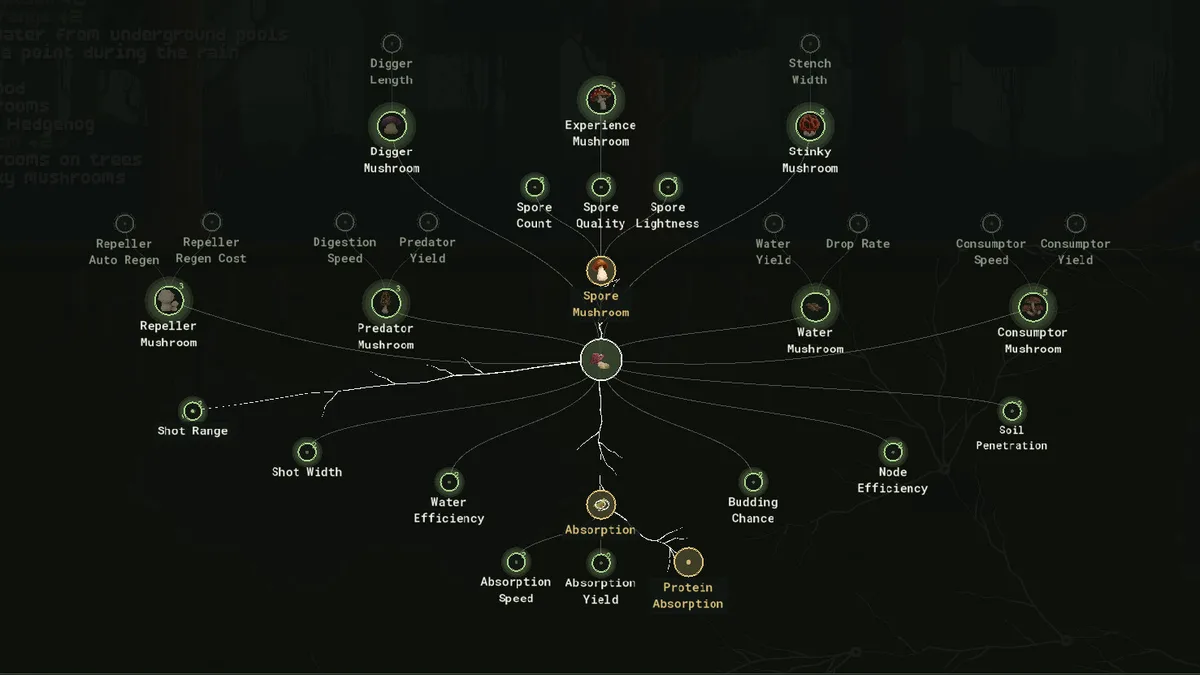
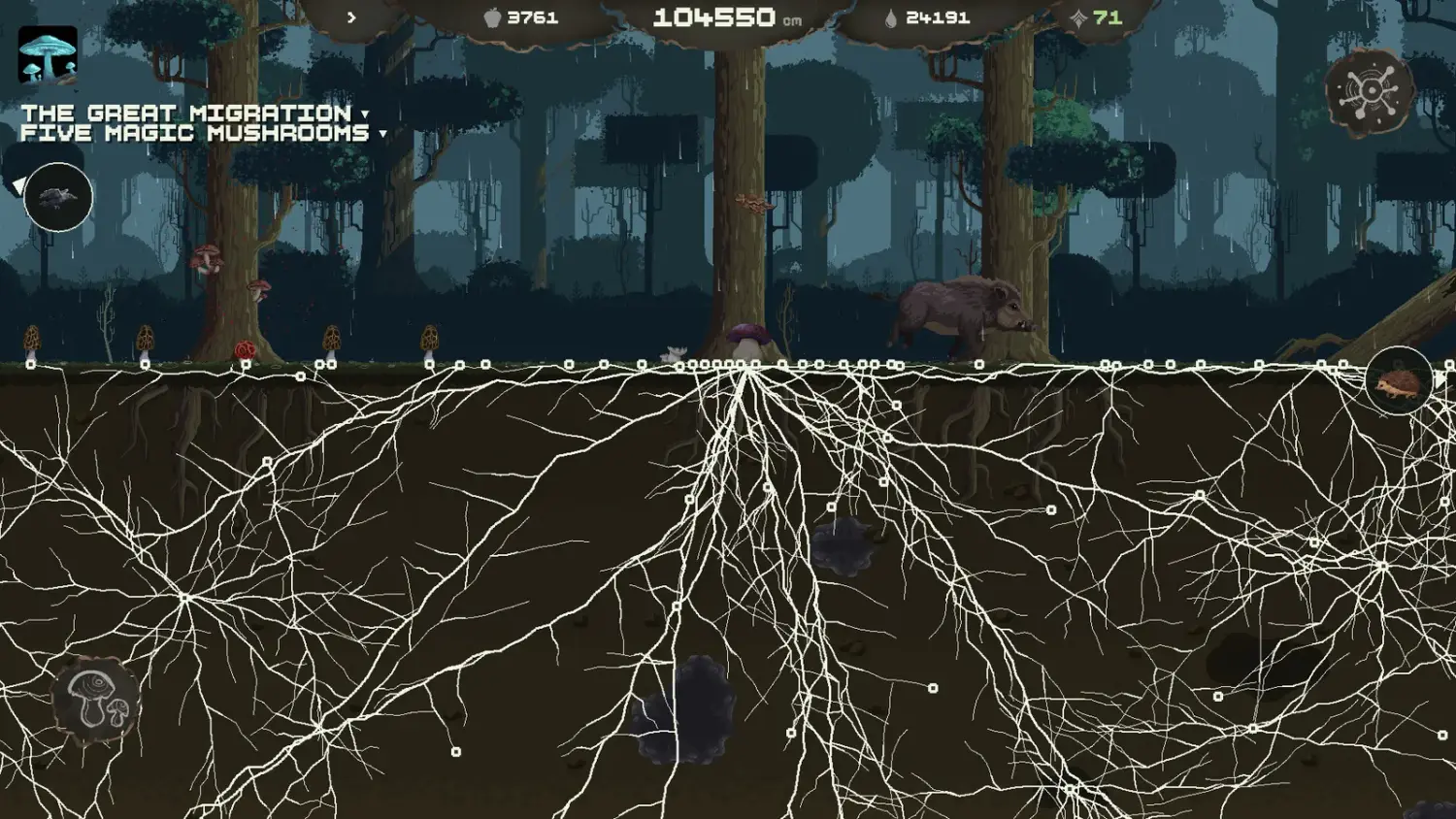
How do mutations work?
Each buildable mushroom has a parent node in the tree and one to three children:
- Predator → Digestion Speed, Predator Yield
- Water → Water Yield, Drop Rate
- Stinky → Stench Width
- Repeller → Auto Regen, Regen Cost
- Digger → Digger Length
- Consumptor → Consumptor Speed, Consumptor Yield
- Spore → Spore Count, Spore Quality, Spore Lightness
- Experience → none
You must buy the parent before the children. The parent unlocks the mushroom for building; the children improve it. A child bought without a built mushroom has no effect because there is nothing to modify.
Which mutations matter most?
The strongest branches are the ones attached to mushrooms you already use every session:
- Repeller Auto Regen — turns a manual defence into a passive one. On a large surface, this is the difference between checking the frontier and ignoring it.
- Predator Yield / Digestion Speed — scales the food engine. Yield increases the output; speed shortens the cycle.
- Water Yield / Drop Rate — makes deep pushes independent of pools.
- Stench Width — covers more assets with the same mushroom.
- Consumptor Speed / Yield — turns trees into a real income source.
The Spore and Digger branches are strong for specific plans but expensive for a general run. Buy them when the plan exists.
A mutation multiplies a system you own. If the system is idle, the multiplier is idle too. Build the mushroom, place it well, then upgrade it.
What does "mutation" mean for magic shrooms?
The five magic shrooms are unique finds with fixed effects, not purchasable mutations. They are sometimes called mutations in community posts because they change how the colony behaves:
- Flora Shroom — reduces the food price of all mushrooms by 25%.
- Water Shroom — sends roots out in random directions from existing nodes.
- Cosmos Shroom — makes the mycelium glow.
- Fauna Shroom — keeps squirrels away permanently.
- Light Shroom — increases production and build speed.
Only the Flora effect is confirmed by an in-game tooltip in the screenshots; the others come from community reports and should be treated as tested-but-unverified until you see them yourself. The magic shrooms guide→ covers locations and the evidence for each effect.
Do mutations change the mushroom's appearance?
The tree does not advertise cosmetic changes. The visible difference players report is behavioural: a Repeller with Auto Regen keeps firing, a Water Mushroom with higher Drop Rate produces more often, and a Spore Mushroom with more Count sends more spores.
If you are looking for visual mutations, the magic shrooms are the system that changes the look of the network. The Cosmos glow is the clearest example, and it is toggled with F.
How should you order mutation purchases?
Use the same rule as the rest of the tree: buy the mutation for the mushroom that is currently doing the most work.
- If food is the bottleneck, buy Predator Yield.
- If animals are the bottleneck, buy Repeller Auto Regen.
- If water is the bottleneck, buy Water Yield.
- If distance is the bottleneck, buy the Spore branch.
- If trees are the bottleneck, buy Consumptor Yield.
Buying a mutation for a mushroom you have not built is the most common waste of points in the game. The upgrade priority guide→ puts the branches in phase order.
Are mutations permanent?
Yes. They are permanent for the run and apply to every mushroom of that type. There is no respec, so a bad purchase stays bought. That is another reason to buy utility first and specialise later.
Between runs, nothing carries over. The knowledge of which branch suits which map does.
FAQ
Are mutations the same as magic shrooms?
No. Mutations are upgrade nodes bought with points. Magic shrooms are five hidden collectibles with fixed effects.
Can I mutate a mushroom I have not built?
You can buy its branch once the parent node is unlocked, but the effect only applies when the mushroom exists.
Which mutation is best for beginners?
Repeller Auto Regen, because it removes a manual chore and protects the food engine. Predator Yield is a close second.
Do mutations stack?
Each node is bought once and applies to all mushrooms of that type. There is no visible stacking of duplicate nodes.
Official source: Mycelarium on Steam ↗ Official source: Update 1.02 notes ↗
The Steam discussions hub ↗ has player reports on which branches feel strongest; the achievement page ↗ confirms the mushroom-count milestones that reward scaling a single type.